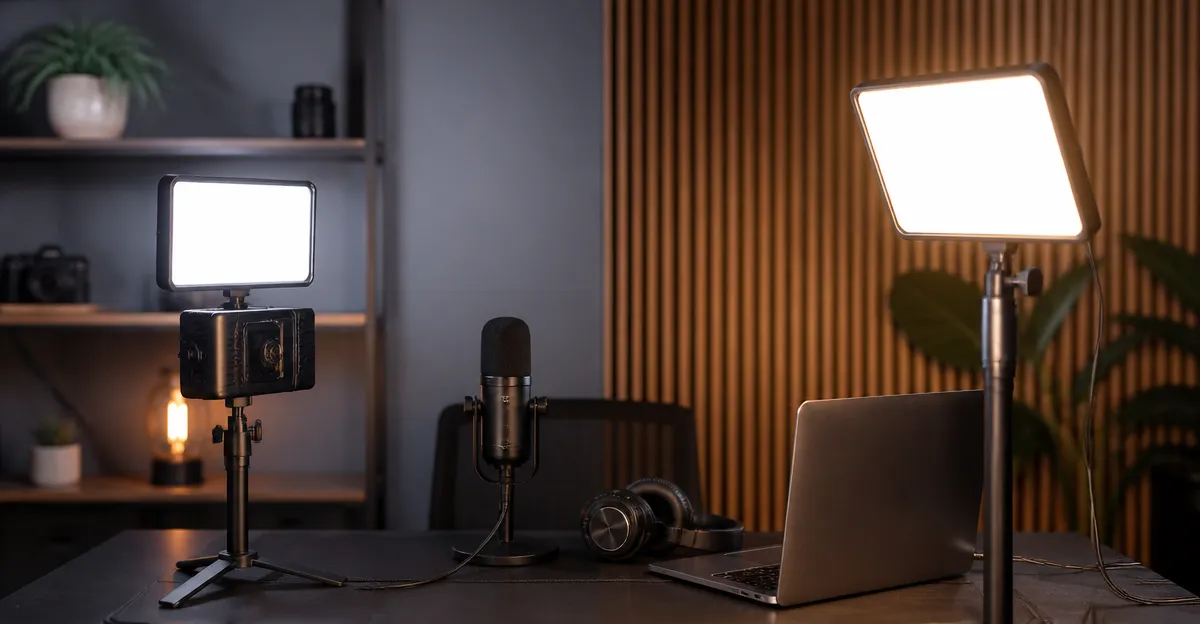
Battery vs AC LED Lights for Podcasting: Neewer & Others
Introduction
On‑location podcasting often requires reliable illumination that can be adjusted quickly and moved easily. This guide explains the essential differences between battery‑powered and AC‑powered LED lighting solutions, and it provides a structured approach for selecting the right kit for a mobile studio. Readers will learn about key technical concepts, see real‑world product examples, and receive actionable best‑practice tips. By the end of the article one will be able to decide which lighting system best matches the demands of a portable podcasting workflow.
Background and Context
LED lighting has become the standard for video and audio creators because it offers high colour rendering, low power consumption, and precise dimming control. Two power modalities dominate the market: battery packs that enable cordless operation, and mains‑connected AC adapters that deliver continuous power without the need for recharging. Battery operation is valuable when shooting in outdoor locations, vehicles, or cramped interiors where power outlets are unavailable. AC operation is advantageous in studio‑like environments where long‑duration recording sessions demand stable output without the risk of battery depletion.
Colour temperature (measured in Kelvin) determines the visual warmth of a light source. Bi‑color panels allow users to shift between warm (around 2700‑3200K) and cool (5600‑6500K) tones, matching ambient daylight or indoor lighting. Brightness is usually expressed as a percentage of maximum output or in lux at a given distance. The Colour Rendering Index (CRI) indicates how accurately a light reproduces colours compared with natural sunlight; values above 95 are considered excellent for skin tones and product work.
For podcasting, the lighting must be soft enough to avoid harsh shadows on the host’s face while still providing enough illumination for the camera sensor. Diffusers, barn doors, and adjustable stands are common accessories that shape and soften the light. Understanding how these accessories interact with power sources helps creators build a flexible lighting kit.
Power Considerations for On‑Location Podcasting
Battery‑powered LED panels typically use rechargeable lithium‑ion packs such as the NP‑F550 or NP‑F970. The advantage is true portability; a single charge can sustain a 40‑watt panel for several hours. However, battery weight adds to the overall load, and users must monitor charge levels during long sessions. AC‑powered panels draw power directly from a wall outlet or USB charger, eliminating the need for battery management but requiring a reliable power source.
When evaluating a kit, consider the following criteria:
- Runtime versus session length: Estimate the total recording time and compare it with the advertised battery life.
- Power flexibility: Some panels support both AC and battery input, offering hybrid operation.
- Heat dissipation: Battery operation can generate heat; metal housings with passive cooling reduce fan noise.
- Portability: Weight of the light, stand, and battery together influences how easily the kit can be transported.
Below are product examples that illustrate these points.
Recommended Products and Their Role
The first product mentioned is the Neewer 2‑Pack Bi‑Color LED Video Lights. This kit provides 40 W bi‑color panels with a colour range of 3200‑5600 K, 0‑100 % dimmable brightness, and a CRI of 96+. Each unit can be powered by an AC adapter or by a NP‑F550/NP‑F970 lithium‑ion battery, making it a true hybrid solution. The metal barn doors and U‑shaped mounting bracket allow precise shaping of the light spill, while the 75‑inch extendable aluminium stand offers stable positioning. With a rating of 4.7 / 5 from 3,895 reviews, users praise its durability and the responsive LCD screen that displays brightness, colour temperature, and battery status.
The second product is the NiceVeedi 2‑Pack LED Video Light Kit. This kit uses 15 W panels with 356 LED beads, a colour temperature range of 2800‑6500 K, and a CRI of 97+. Power is supplied via USB‑C from a wall charger, power bank, or laptop, providing true cordless operation without a dedicated battery pack. The aluminium tripod extends to 60 inches and folds to 17 inches for travel. Reviewers highlight the remote‑controlled brightness (10‑100 %) and the ease of switching between warm and cool tones.
The third product is the NiceVeedi 2‑Pack Studio Light Kit. This system delivers 36 W bi‑color output (2700‑6500 K) with a 1 % precise brightness control and built‑in 4‑leaf barn doors. The panels include an infrared remote that operates up to 8 m away, and the aluminium tripods adjust from 41 inches to 72 inches. The high CRI of 95+ ensures accurate skin tones, making it suitable for close‑up interview setups.
The fourth product is the Amazon Basics RGB LED Video Light Kit. This kit focuses on creative colour effects with seven RGB presets and three colour temperatures (2500‑6500 K). It is USB‑powered, allowing connection to a power bank or laptop. Although the output is lower than the professional kits, the lightweight design and 62.3‑inch adjustable tripod make it a practical choice for vlog‑style podcasting where visual flair is desired.
The final product is the EMART 2‑Pack LED Video Light Kit. It offers a wide colour temperature range of 2800‑7000 K, ten brightness levels, and a magnetic barn door for precise light shaping. Power is supplied via USB (5 V/2 A), and the 12‑inch panels are compact enough to fit on a desk. Reviewers appreciate the sturdy aluminium tripod that reaches 73 inches, and the kit includes a phone holder, making it ideal for mobile interview recordings.
Comparison and Selection Guide
The table below summarises the key attributes of each kit, focusing on power mode, output, colour temperature range, CRI, stand height, and price.
| Product | Power Mode | Output (W) | Colour Temp (K) | CRI | Stand Height | Price (USD) |
|---|---|---|---|---|---|---|
| Neewer 2‑Pack Bi‑Color | AC & Battery | 40 | 3200‑5600 | 96+ | 26‑75 in | 199.99 |
| NiceVeedi 2‑Pack LED Kit | USB (Battery via Power Bank) | 15 | 2800‑6500 | 97+ | Up to 60 in | 42.59 |
| NiceVeedi 2‑Pack Studio Kit | AC Adapter & USB | 36 | 2700‑6500 | 95+ | 41‑72 in | 89.99 |
| Amazon Basics RGB Kit | USB | Not specified (low) | 2500‑6500 | Not specified | Up to 62 in | 34.99 |
| EMART 2‑Pack LED Kit | USB (Power Bank) | 15 | 2800‑7000 | 97+ | 19‑73 in | 40.41 |
When selecting a kit, match the power mode to the typical recording environment. For outdoor street interviews, a USB‑powered kit with a power bank (NiceVeedi or EMART) offers true mobility. For indoor studio pods where a wall outlet is always available, a hybrid system like Neewer provides the flexibility to switch between AC and battery without swapping panels.
Budget is another decisive factor. The Amazon Basics RGB kit and NiceVeedi 2‑Pack LED kit are under $45, making them suitable for entry‑level creators. The Neewer kit, while more expensive, delivers higher output and a more robust metal construction, which can justify the investment for professional podcasters who require consistent colour fidelity.
Best Practices & Tips for Podcast Lighting
- Use a 45‑degree key light: Position the main LED at a 45‑degree angle to the host’s face to create natural modelling shadows.
- Employ a fill light: A second, lower‑intensity panel placed opposite the key light reduces harsh contrast.
- Softening the light: Attach the supplied soft diffuser or a cheap white parchment paper to the panel to achieve a flattering, even illumination.
- Control colour temperature: Match the panel’s Kelvin setting to the ambient light source; for indoor rooms with typical warm lighting, set the panel around 3200‑3500 K.
- Monitor battery levels: When using battery‑powered panels, check the LCD readout before each session and keep a spare power bank on hand.
- Secure the stands: Extend the tripod legs fully and lock the knobs tightly; use the built‑in barn doors to prevent spill onto the background.
- Test with the camera: Adjust exposure on the camera while the lights are on; fine‑tune brightness using the panel’s dimming control rather than relying on camera ISO alone.
Frequently Asked Questions
- Can I use a battery‑powered LED panel with a standard AC outlet? Yes, many panels, such as the Neewer Bi‑Color kit, accept both AC adapters and removable lithium‑ion batteries, allowing seamless transition between power sources.
- How long does a typical battery‑powered panel last? Runtime varies with brightness; at 50 % output a 40 W panel usually lasts 2‑3 hours, while lower‑wattage USB‑powered panels can exceed 4 hours on a full power‑bank charge.
- Do I need a separate charger for the USB‑powered kits? No, the NiceVeedi and EMART kits draw power directly from any 5 V/2 A USB source, including wall adapters, laptops, or power banks.
- Is a higher CRI important for podcasting? A CRI above 95 ensures accurate skin tones and colour reproduction, which is valuable when the video will be streamed or recorded for later editing.
- Can I control the lights remotely? The NiceVeedi Studio Light Kit includes an infrared remote with an 8‑meter range, and the Neewer kit provides an LCD screen for manual adjustments; both options reduce the need to touch the panel during a live recording.
- What is the advantage of built‑in barn doors? Barn doors shape the light beam, limiting spill onto the background and allowing the creator to create dramatic contrast without additional modifiers.
- Are these kits suitable for multi‑person podcasts? Yes, by using two panels—one as a key light and the other as a fill or hair light—one can achieve even illumination across several hosts.
Conclusion
Choosing between battery and AC LED lights for on‑location podcasting hinges on mobility, runtime, and budget. Hybrid systems such as the Neewer Bi‑Color kit deliver the best of both worlds, while USB‑powered kits from NiceVeedi, Amazon Basics, and EMART provide lightweight, cost‑effective solutions for creators who rely on power banks. By evaluating colour temperature range, CRI, stand flexibility, and price, podcasters can assemble a lighting rig that enhances visual quality without compromising portability.
Implementing the best‑practice tips—proper key‑fill positioning, diffusion, and consistent colour matching—will further ensure professional‑grade results. Whether recording in a coffee shop, a rented studio, or a home office, the right LED lighting system empowers creators to focus on content while the light works silently in the background.
Products Featured in This Guide
Neewer 2‑Pack Bi‑Color LED Video Lights
Price: $199.99 | Rating: 4.7/5 (3,895 reviews)
Featured because it offers hybrid AC/battery operation, high CRI, and robust metal construction suitable for professional‑grade podcasting.
NiceVeedi 2‑Pack LED Video Light Kit
Price: $42.59 | Rating: 4.4/5 (5,588 reviews)
Featured for its USB‑C power flexibility, three colour‑temperature presets, and remote‑controlled dimming, making it ideal for portable setups.
NiceVeedi 2‑Pack Studio Light Kit
Price: $89.99 | Rating: 4.4/5 (305 reviews)
Featured for its higher 36 W output, built‑in barn doors, and infrared remote, providing precise control for multi‑person podcasting.
Amazon Basics RGB LED Video Light Kit
Price: $34.99 | Rating: 4.4/5 (215 reviews)
Featured because of its RGB colour options and ultra‑slim USB‑powered design, which adds creative lighting possibilities for vlog‑style podcasts.
EMART 2‑Pack LED Video Light Kit
Price: $40.41 | Rating: 4.3/5 (4,406 reviews)
Featured for its wide colour‑temperature range, magnetic barn doors, and compact USB power, which suits desk‑based interview recordings.